
I went to see Hamnet at the cinema, with Jessie Buckley as Agnes and Paul Mescal as Shakespeare. I had been warned partway through that it would be very sad, that I might want a handkerchief ready. But the tears didn’t come where people expect them to.
We all know the child dies. That isn’t the surprise.
From the opening scenes, the film was already working on me. Trees, leaves, sunlight. Agnes lying against the great exposed roots at the base of a tree, buttress roots, grounding and ancient. It took me straight to my own wood. Not as an image, but as a felt place. Nature here isn’t background or metaphor. It is presence. Teacher. Companion.
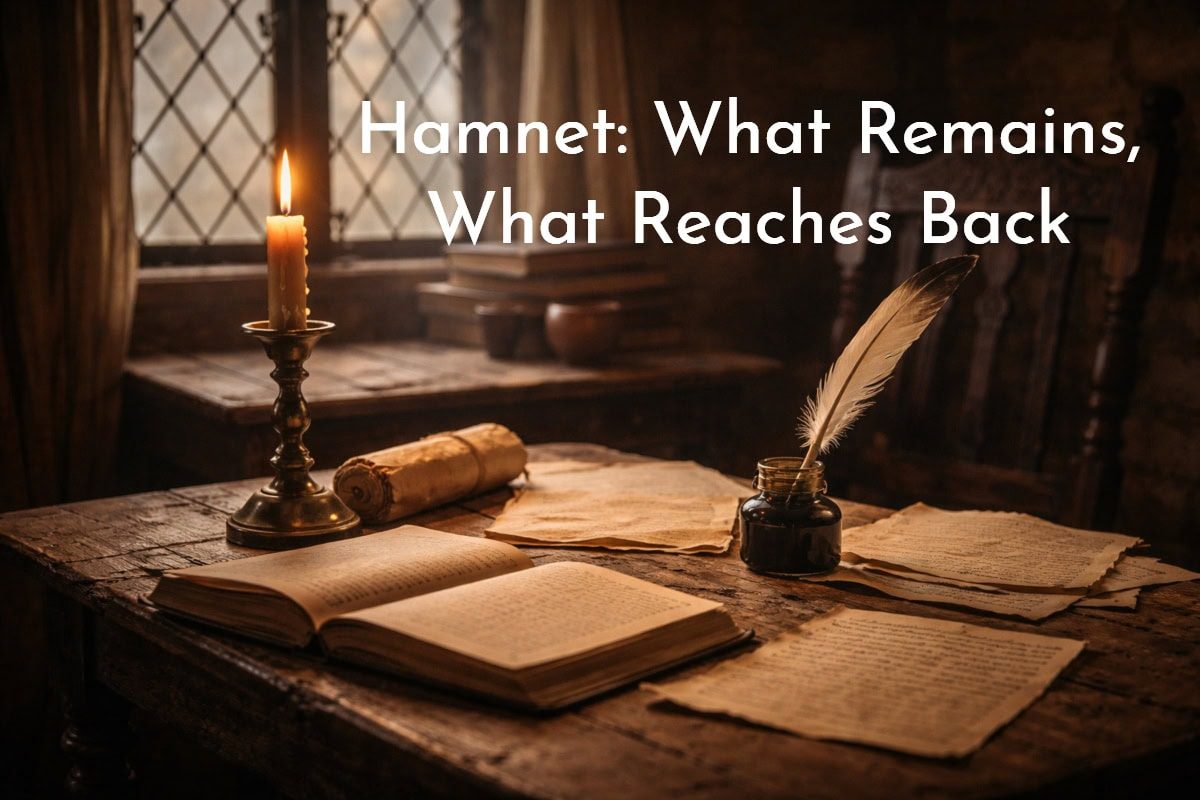
The cinematography matters. Much of the film unfolds in darkness or half-light, shaped by a pre-electric world of candlelight, fire, and shadow. Interiors glow rather than shine. Faces emerge slowly. It creates an atmosphere that feels intimate and enclosed, as if life itself is being lived close to the edge of night. The darkness is not threatening, but elemental, reminding us how differently people once inhabited time, space, and loss.
Agnes is portrayed as wild in the truest sense. Not untamed, but deeply attuned. Her mother comes from the woods. She has a hawk. Again and again, she holds people’s hands, firmly, deliberately, as if reading something essential through touch. When she first meets Will Shakespeare, she does this. She does it with others too. It is her way of knowing. Of truly connecting.
That way of listening resonates strongly with how I live now. I listen to nature. I take cues from it. I use it to understand myself. Nature, for me, has become a very good teacher.
The film doesn’t soften the realities of 16th-century life. Childbirth is dangerous. Illness is common. Death is everywhere. Watching it, I felt grateful for modern medical interventions, and at the same time aware of what we have lost. Death then belonged to life. It wasn’t hidden away. There was more death, but also more familiarity with it. Less technology. More reality.
Seeing Shakespeare himself in this context was unexpectedly affecting. Not the monumental literary figure, but a man pulled between home and obligation. After the death of his son, he returns to London because the theatre company needs him. He does not stay to grieve alongside his wife. That is partly necessity, partly avoidance, and partly the way work so often becomes a refuge.
That pattern felt familiar. There were years when I left home on Sunday evening and returned on Friday night, travelling for consultancy work. Well paid, yes. But not kind to personal life. The film doesn’t judge him for leaving. It simply shows the cost.
One of the most talked-about moments is Agnes’s scream when she learns of her son’s death. It is raw and animal, and people often remark on it. Watching that scene stirred something I had forgotten. I have screamed like that. Louder, longer. I screamed until there was nothing left, and then I collapsed, completely spent.
I had sealed that memory away. Not erased it, just stored it without words. The film didn’t overwhelm me by bringing it back. It reminded me. It returned something lived, something bodily, that had never been properly named.
Near the end of the film, Agnes goes to the Globe Theatre with her brother. Until this point, I am not sure she has fully understood what Shakespeare’s work is doing in the world. She knows he writes; she knows the theatre claims him, but the meaning of it feels distant, abstract.
Standing among the groundlings, she finally hears the words as they land on other people. At first she is restless, almost shouty, especially when she realises their son is being invoked on stage. And then something shifts. She grows still. She begins to listen. It is as if she is absorbing, perhaps for the first time, what his work offers to others, and why it matters beyond their private grief.
Shakespeare is on stage, playing the ghost. At one point, he sees her in the crowd. Something passes between them, not spoken, but felt. A recognition, perhaps. Or a deeper understanding, shaped not through conversation, but through what the play itself is holding.
When the actor playing their son appears, Agnes reaches out and touches him. Others reach out too. It echoes the way she has always known the world, through touch, through contact, through presence. Max Richter’s music rises, steady and insistent, and the boundary between past and present feels thin enough to cross.
That was when the tears came. Not sharply, just steadily.
Watching that scene also folded my own past into the film. My second husband and I once had season tickets at Shakespeare’s Globe. We began as groundlings, then endured the hard benches, and eventually had a box. We took food and drink. We went to every play, every year, for several years. Seeing the Globe on screen brought all of that back, quietly and without drama.
I saw the film with my friend Kate, and I was glad of that. There is something steadying about watching a film like this alongside someone else. You don’t have to explain your response. You don’t have to manage it alone. The experience is shared, even in silence.
As the film drew to a close, there was no sense of resolution, no neat easing back into light. What stayed with me was the quiet aftershock of it. I left the cinema feeling drained and slightly shell-shocked, in a good way. As if something had been loosened, or gently rearranged.
My film reviews are never about what happened on screen. They are about what lingers afterwards. Hamnet stayed with me. And I suspect it will continue to do so, quietly, for some time.