
I hadn’t planned to watch King and Conqueror (a BBC drama) I already knew it wasn’t historically accurate. You expect a bit of dramatic licence in this sort of production, but what they’ve done here goes far beyond tightening timelines or simplifying subplots. They’ve changed major events, invented confrontations, and layered in symbolism that has no grounding in reality. And I’ve never understood why filmmakers feel the need to rewrite history when the truth is rich enough on its own.
So yes, as a historical drama, it was a disappointment. But as I watched, certain moments still stood out, not because they were true to 1066, but because they revealed something familiar about human behaviour.
What struck me most was the force of ambition. Nobody in this story is satisfied. Everyone wants more; more land, more power, more certainty, more recognition. Even when things could have been stable, they reach for the next rung. It’s framed as medieval struggle, but you see versions of this every day. At work, in organisations, people jostle for promotions, claim ownership of things they didn’t do, and manoeuvre around each other. And like in 1066, it rarely ends well. Ambition has a cost, whether the battlefield is made of mud or meeting rooms.
The scenes on the battlefield captured something, strangely, more real than the invented plot around them. The shouts through the ranks: Hold the wall. Hold the line. That felt authentic. No drones, no distance. Just bodies, shields, spears, slipping in mud, breath against breath. The English shield wall was strong as long as they held formation. Harold knew this, which is why he kept telling them to stay steady.
But then came the familiar moment: the Normans retreating, genuine or feigned, and the English chasing despite clear instructions not to. One break in the line, and everything collapses. That pattern repeats throughout history and in life. People often know what they are meant to do, but impulse, excitement, fear, or a desire to act can unravel the whole structure. I’ve seen it working with others in woodland: a task explained clearly, but someone decides to do their own version and efficiency, safety, and purpose fall away. “Hold the line” works as much in modern life as it did on Senlac Hill.
The drama added its own theatrics, of course. William appearing to fall, the rumour he is dead, and the English losing discipline. That part, at least, echoes something real, William did have to show his face to rally his men. But the film’s version of Harold and William meeting in single combat is pure invention. They never fought one-on-one. They never even laid eyes on each other during the battle. Still, the invented hesitation, Harold pausing when he could have struck, had a strange symbolic truth. History doesn’t hinge on moments like that, but people do. Hesitation has shaped many lives, even if not this battle.
And then the drama slid fully into myth. In the film, Harold hesitates, someone else stabs him, and as he lies dead, William takes an arrow and punches it into his eye. I laughed. No subtlety there. One of his lackeys even declares that the arrow came from God.
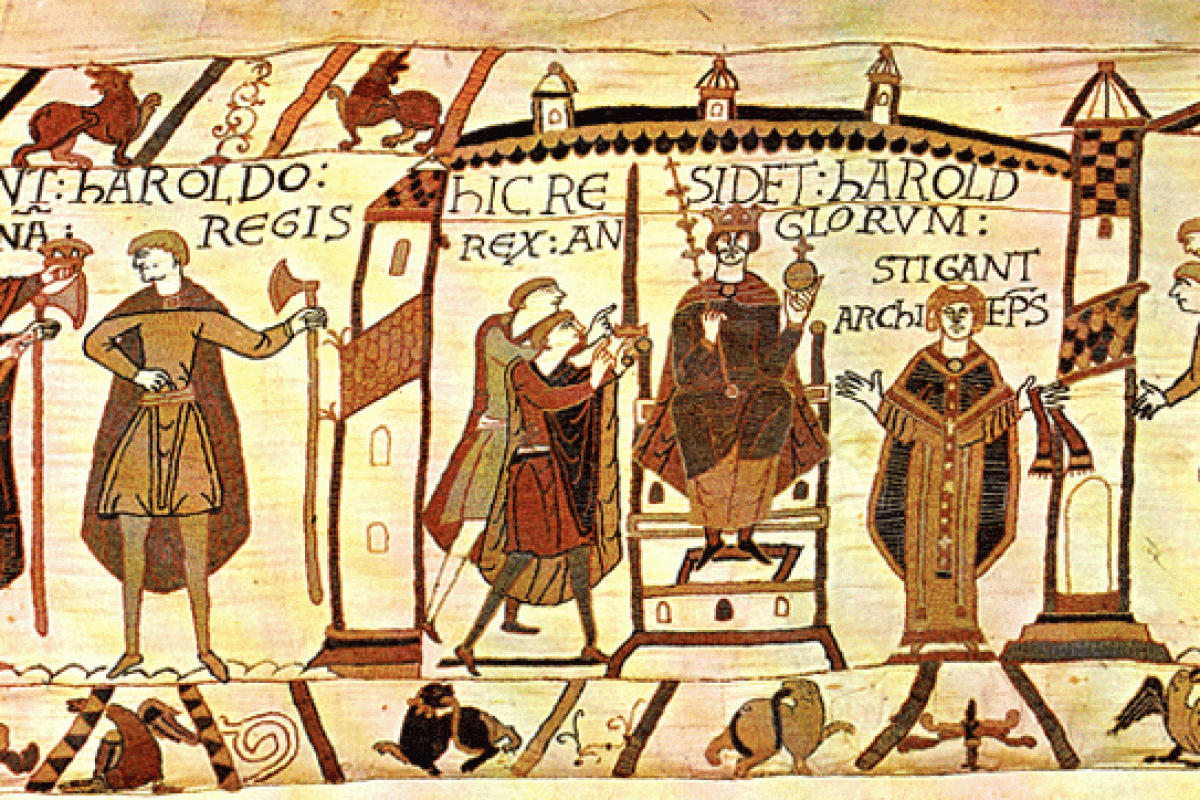
Harold’s death becomes “the hand of God,” the arrow framed as divine judgement. When Edith identifies the body, she is forced to repeat the lie, and William solemnly pronounces it to the people. It’s propaganda dressed up as revelation, the old Norman narrative that victory equals divine approval. The real Harold almost certainly died in the final crush when the shield wall broke. No heavenly archery required.
By the end, with William crowned and Morcar conveniently standing by to endorse the new order, I found myself thinking: What a load of garbage. Not because the story of 1066 is boring, but because they’ve replaced complexity with cartoonish symbolism.
And yet, watching it reminded me of something. The past, even when mangled by scriptwriters, still illuminates the present. Power struggles, ambition, fear, loyalty, hesitation, holding the line, breaking formation … these patterns run through human life. You can see them in medieval battles, in workplaces, in communities, and in families. The drama didn’t tell the truth of 1066, but it did shine a light on some truths about us.
I don’t write these reviews for likes or attention. I write them because the act of watching, noticing, and thinking matters to me. Even a badly told story can offer something worth reflecting on, if only a reminder that the real history is still the more interesting version.