
Most of us carry a faint, inherited picture of what a retirement community looks like. Sunshine, leisure, golf carts, cheerful marketing. A softer life. A quieter world. Somewhere else.
And then a book like Seniorland forces you to look again.
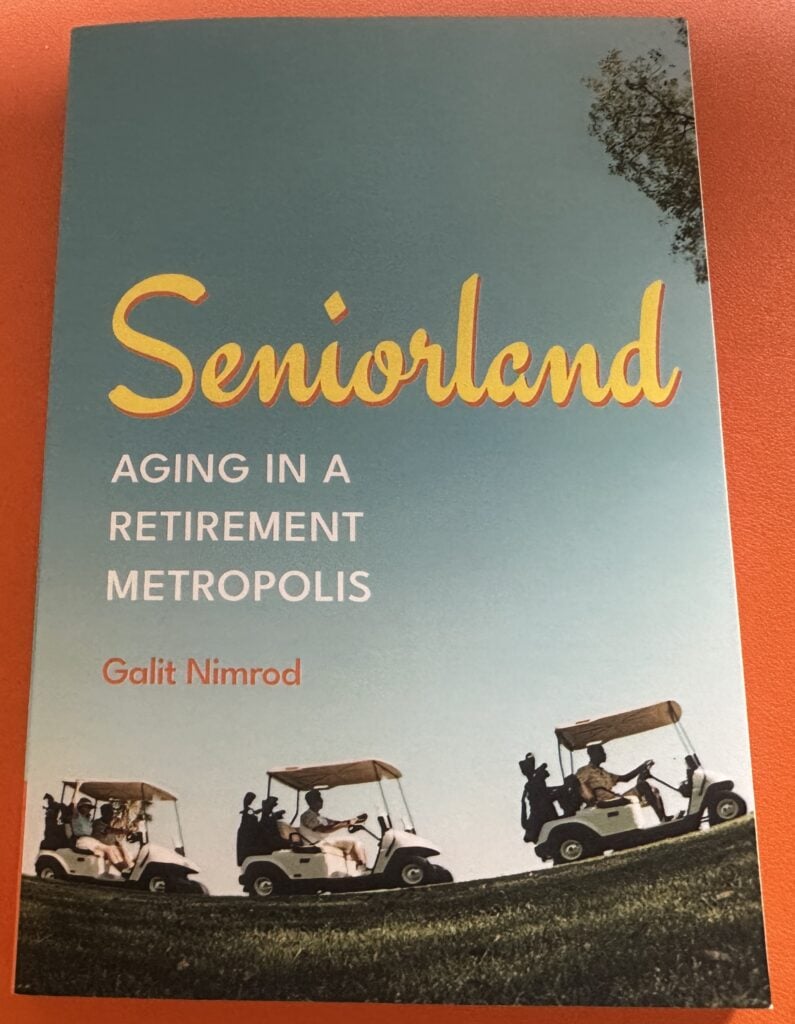
A few months ago, I reviewed Galit Nimrod’s ethnographic study of a large, age-segregated American retirement community. I expected something observational, perhaps even familiar. What I found instead was a rare window into a parallel society, one created almost entirely by older adults themselves.
Revisiting it now, at a time when longevity debates, “redesigned retirement,” and Silicon Valley promises about ageing are everywhere, the book feels newly relevant. Not because it offers answers, but because it reveals something we underestimate in the UK:
later-life living is shaped far more by the environments available to us than by personal attitude or lifestyle choices.
In Britain, the conversation often leaps straight to tiny homes, co-living, pocket neighbourhoods and “age-friendly design.” But these ideas remain largely aspirational, accessible mainly to the affluent. We do have over-55s developments, from gated communities to Churchill, McCarthy & Stone and Pegasus apartments, yet these tend to offer housing rather than a fully designed social world, and they serve only a small, relatively well-off segment of older adults. We have no equivalent of the large-scale American retirement metropolis, and very few mid-range or scalable options. For most people, ageing still unfolds in ordinary houses on ordinary streets, with support systems that are fragmented, inconsistent and rarely designed with later life in mind.
Which is precisely why Nimrod’s work matters. It shows what becomes visible when later life is lived inside a community structured for ageing, its freedoms, its tensions, its reinventions, its quiet daily negotiations.
It reveals not a utopia or an escape, but a social world that tells us far more about ageing than any wellness slogan ever could.
And that is where Seniorland becomes a lens for something much larger.
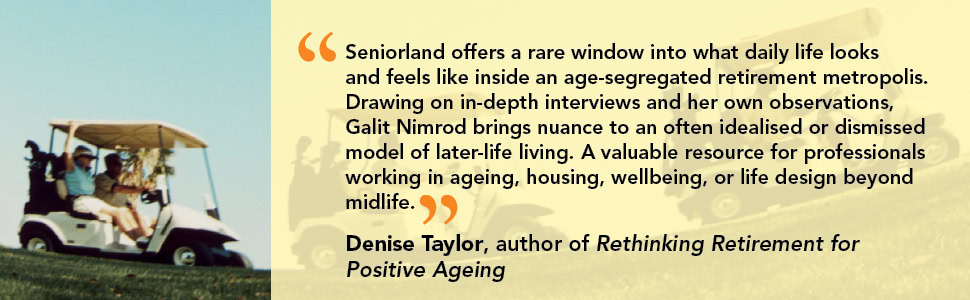
The retirement metropolis: not quite utopia, not quite refuge
One of the most striking insights from Seniorland is that life inside a retirement community is not simply a softer, slower version of ordinary life. It is a distinct social world with its own rhythms, power structures, unwritten rules and emotional currents.
Residents were not “waiting out” their later years. They were:
- forming new identities
- renegotiating independence
- crafting daily routines
- finding belonging
- navigating loss
- renegotiating how they wished to be seen
Some embraced the community as a chance to start over, freed from the expectations of midlife. Others found the environment both comforting and constraining, an insulated world where your age group is suddenly the only age group.
Age segregation, Nimrod notes, does not automatically produce harmony. It can produce solidarity, yes, but also hierarchy, status anxieties, cliques and subtle forms of exclusion. In other words, it is real life, just at a different stage.
What made the community work wasn’t homogeneity. It was the shared understanding that everyone was navigating something: decline, possibility, renewal, loneliness, companionship, resilience.
This mirrors what I see in my own work: olderhood is never a single story.
Ageing is social, not just personal
Nimrod’s research illustrates beautifully how deeply we are shaped by the environments we age within. We often treat ageing as an individual challenge: “stay active,” “stay connected,” “stay positive.” But context matters enormously.
In a retirement metropolis, the context changes everything:
- belonging is more accessible, because everyone is in a similar life phase
- loss is more visible, because it happens within a tight-knit community
- purpose must be reinvented, because traditional roles have receded
- identity is renegotiated, often in subtle daily ways
Older adults became not just residents but participants in the social experiment of later life.
Reading Nimrod alongside the newer wave of commentary on ageing, including from the longevity movement, I’m struck by how few discussions account for the lived, communal fabric of ageing.
We talk about “designing a long life,” but rarely about the design of the environments in which long lives unfold.
A contrast to The Villages and the American longevity narrative
In the US, writers like Bryan Kelly, who moved into The Villages in his forties to study it from within, explore retirement communities as microcosms of cultural change. That work has value, but it often reflects an American framing of scale, reinvention and optimism.
Nimrod’s Israeli perspective is quieter, more ethnographic, more psychologically attuned. It doesn’t romanticise, nor does it condemn. It watches closely.
Where American commentary often focuses on lifestyle, Nimrod examines:
- meaning
- belonging
- coping strategies
- identity shifts
- the emotional texture of daily life
Her work sits closer to the questions that interest me: how older adults make sense of themselves when the structures that once defined them fade away.
Retirement communities as mirrors, not escapes
Something Nimrod captures with great sensitivity is that moving into a retirement community doesn’t erase life’s struggles. It simply creates a new container for them.
People bring themselves, their histories, their losses, their habits, their unresolved tensions, their hopes and capacities. The community amplifies some aspects and cushions others.
For some, it offered liberation.
For others, containment.
For most, a peculiar blend of both.
This, to me, is the real insight: ageing is not about escape; it is about reintegration.
Even in an age-segregated environment, the work of later life, meaning, relationships, identity, continues.
Why this matters now
We are entering an era where:
- people will live decades beyond traditional retirement
- older adults will reshape culture as they go
- new forms of later-life living will emerge
- belonging will matter more than ever
And yet very little of our public discourse reflects the lived reality of older adulthood.
Nimrod’s work reminds us that if we want to understand ageing, truly understand it, we need to pay attention to how older people create worlds, not just how they survive them.
What I’m left with
Revisiting Seniorland now, I’m struck by how much of what she documented resonates with what I hear from clients and readers:
- the desire for clarity
- the need for spaciousness
- the pull toward meaningful connection
- the renegotiation of self after decades of doing
- the tension between independence and community
Ageing, at its heart, is not decline. It is reorientation.
Wherever and however we grow older, in a retirement community, a city flat, a semi-detached house, a co-living experiment, or alone, the questions of later life always return to the same quiet terrain:
What matters now?
Who am I becoming?
Where do I belong in this next part of life?
Seniorland doesn’t offer solutions. It offers a mirror. It shows what older adults create when they are given structure, proximity and the freedom to shape their days. And it exposes something we rarely confront here in the UK:
Most of us will age inside environments never designed for long life. And yet those environments will shape us all the same.
The book leaves me with a lingering question, one that stretches far beyond any single community:
If the social architecture of ageing influences who we become, what kinds of environments are we willing to imagine, and build, for the decades ahead? That, to me, is the real work of Olderhood