
I’m not a football fan.
Or at least, that’s what I’ve always said.
And yet, there I was, sitting down properly, not half-reading the paper, not doing something else at the same time, but really watching Macclesfield FC play Crystal Palace. Wanting to feel every minute of it.
Part of it goes back a long way.
I was born in 1957, and as a child my dad used to take me to football matches. I think, if I’m honest, he might have wanted a son. Instead, he had me, and I went along anyway. We travelled all over the North West, watching the two local teams: Witton Albion and Northwich Victoria. Non-league football.
These weren’t glamorous clubs. The players had jobs. The directors were people you knew. My dad was a director at Witton Albion, and the club had a social room with bands and discos. As a teenager, barely fourteen, I went dancing there with my friends, watched over by familiar adults who made sure nothing got out of hand. It sounds almost shocking now, but that was life in the early 1970s, hanging out with older men, serving tea and pork pies from the tea hut. Football wasn’t a spectacle. It was woven into ordinary community life.
So, when I found myself watching Macclesfield, it wasn’t because I suddenly wanted to understand formations or tactics. It was because Macclesfield FC was once Macclesfield Town. Because I remembered seeing them play when I was young. Because people I knew lived there. Because place, memory, and identity have a way of resurfacing when you least expect them to.
And then there was the story itself.
We all love an underdog, don’t we? Wrexham showed us that on a grand, televised scale. But Macclesfield’s rise has been quieter. A club brought back to life. A ground restored. A team rebuilt season by season. Watching the owner on screen, visibly proud, talking about bringing the heartbeat back, it didn’t feel like corporate ownership. It felt like stewardship. Care. Responsibility.
The football reflected that.
They weren’t prima donnas. They played as a team. Calm, focused, enjoying the game because nobody expected them to win. That, I realised, might be the secret. When you’re not in awe of the opposition, when you’re not frozen by status or reputation, you play your own game. You do your best. You stay present.
The goals weren’t polished masterpieces. One of them was messy. Bodies everywhere. Someone on the ground. The ball breaking loose. And then suddenly, joy. Real joy. The kind that makes you laugh out loud.
As the minutes ticked on, the tension was almost unbearable. A late Crystal Palace goal at 90 minutes. Six minutes added.
The captain coming back on with his head strapped. The manager pointing to his head, reminding everyone not to panic. Calm holding the line.
And then the final whistle.
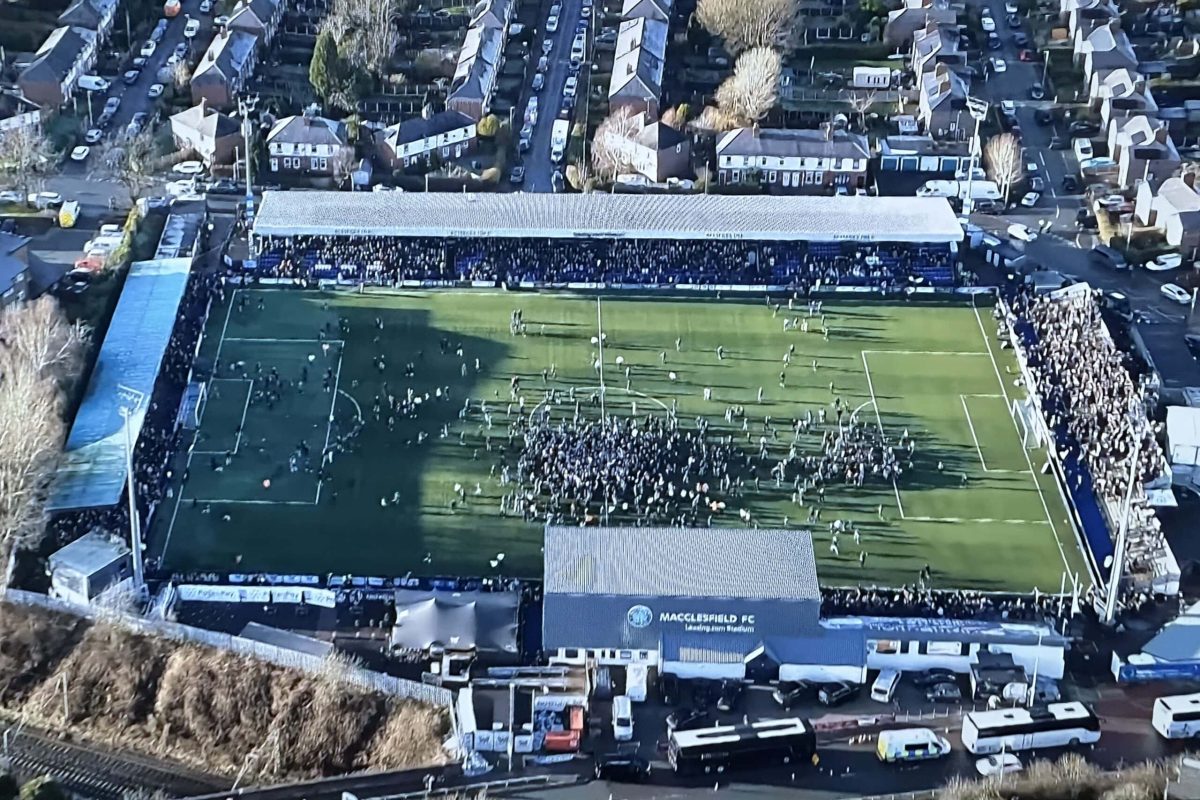
The crowd spilled onto the pitch. Not as spectacle, but as release. Arms around strangers. Disbelief. Delight.
Macclesfield 2, Crystal Palace 1.
The commentators said Macclesfield were the best team on the day, and they were. But what mattered to me wasn’t what anyone else said. It was how it felt. I didn’t want to be told how to feel. I already knew.
This wasn’t about elite football or global brands. It was about something local, human, and real. Supporters rather than distant fans. People who turn up, who carry history with them, who recognise themselves in a team that refuses to disappear.
I’m still not a football fan, in the conventional sense. But Saturday afternoon, watching Macclesfield, I understood again why football once mattered so much in my life.
Not for the glory.
Not for the money.
But for the joy of seeing something held together, brought back to life, and shared.
And that, honestly, was magic.