
There are moments when a piece of work arrives not as a sudden idea, but as something that has been quietly forming over many years.
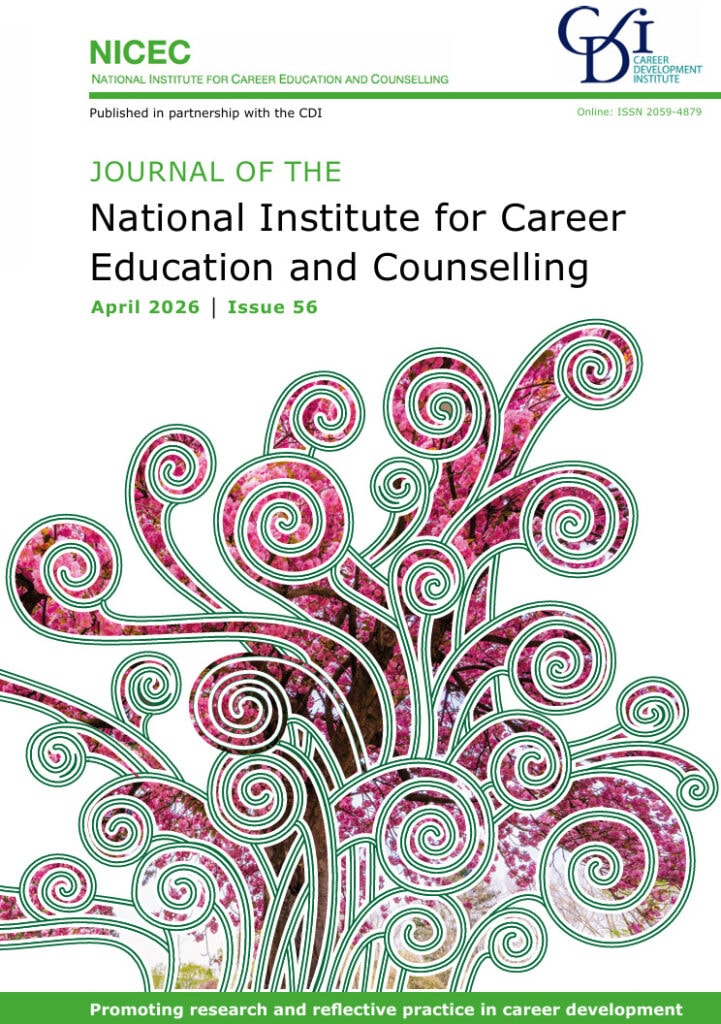
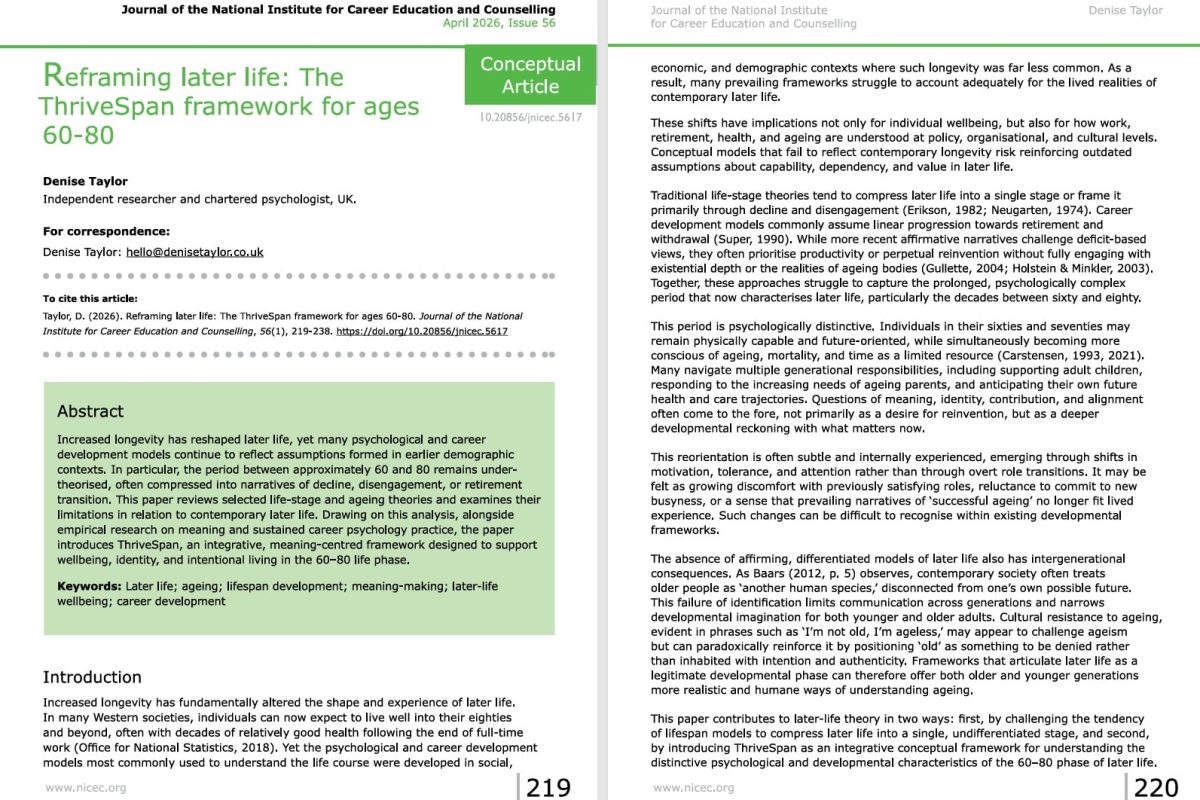
I’m pleased to share that my peer reviewed paper, Reframing later life: The ThriveSpan framework for ages 60–80, has now been published in the Journal of the National Institute for Career Education and Counselling (NICEC).
At one level, this is an academic paper. It engages with lifespan psychology, career development theory, and contemporary models of ageing. It examines the limitations of many existing frameworks, particularly the tendency to compress later life into either decline, withdrawal, or endless reinvention.
But ThriveSpan did not begin as theory.
It emerged gradually through years of listening to people in their sixties and seventies speak about what was really happening in this phase of life. Not simply retirement decisions or practical planning, but deeper questions around meaning, energy, identity, sufficiency, contribution, and how life feels when time becomes more visible.
It also emerged through my own experience of growing older.
Over time, I became increasingly aware that much of the language around ageing no longer reflected what I was observing, either professionally or personally. Some models still framed later life largely through decline. Others responded by promoting a kind of perpetual optimisation, as though ageing well meant staying endlessly productive, youthful, or reinvented.
Neither fully captured the quieter psychological shifts I kept noticing.
The paper argues that the years between approximately 60 and 80 represent a distinct developmental phase, one shaped less by accumulation and more by reorientation. A gradual movement towards discernment. Towards deciding more consciously where time, energy, and attention are placed.
For many people, this phase brings a different relationship with achievement, busyness, relationships, health, creativity, and meaning itself. Questions begin to change. The focus often softens from “What else can I build?” towards “What matters now?”
That does not mean withdrawal from life. If anything, it can involve a deeper engagement with it, but often in more selective, intentional, and internally aligned ways.
The ThriveSpan framework grew from this recognition. It brings together nine interconnected dimensions across wellbeing, reflection, belonging, contribution, creativity, fulfilment, autonomy, joy, and meaning. Not as a prescription for ageing, but as a reflective framework for understanding the complexity of this phase of life.
Perhaps most importantly, ThriveSpan was never intended to be purely academic. The theory came later. The lived experience came first.
Some of the ideas in the paper were shaped sitting with coaching clients. Some emerged during doctoral research into meaning after full-time work. Others surfaced slowly during time spent alone in the woodland, reflecting on what changes as we grow older and what remains essential underneath it all.
In many ways, this publication feels less like a conclusion and more like part of a wider unfolding conversation about how we understand later life in a world where longevity has changed so much, but our psychological frameworks have often lagged behind.
For those interested, the paper is published in NICEC Journal, Issue 56.
And for me personally, it represents something I care deeply about, offering a more humane, nuanced, and psychologically grounded way of understanding later life beyond the old narratives of decline or the pressure to endlessly optimise ourselves.
ThriveSpan continues.